QUAB-SPEZIALITÄTEN

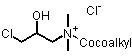
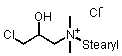
Lösungen des Wirkstoffs 3-Chlor-2-hydroxypropyl-alkyl-dimethylammoniumchlorid.

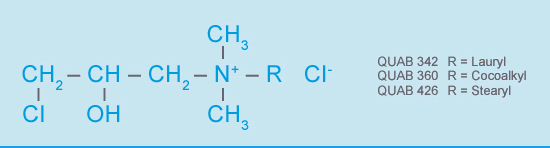
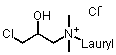
We also offer the QUAB Specialties QUAB 342, QUAB 360 and QUAB 426, which are the trade names for the solutions of the active substance 3-chloro-2-hydroxypropyl-alkyl-dimethylammonium chloride. In these products, a methyl group within the quaternary ammonium group is substituted by a long-chain alkyl group (R = dodecyl-, cocoalkyl- or stearyl-). These products are delivered exclusively as chlorohydrins.

QUAB 342 and QUAB 360 are sold as aqueous solutions with total active weight concentrations of approx. 40 % (chlorohydrin).

QUAB 426 is sold as a solution in a 1,2-propanediol / water mixture with approx. 40 % weight concentration (chlorohydrin)

QUAB 342
QUAB 360
QUAB 426

Empirische Formel

C17H37Cl2NO
C13-23H29-49Cl2NO
C17-32H37-49C12NO

CAS.-Nummer.

41892-01-7
690995-44-9
3001-63-6

EINECS-Nr.

255-578-9
440-100-5
221-083-1

Molekulargewicht

ca. 342 g/mol
ca. 360 g/mol
ca. 426 g/mol

Erscheinungsbild

Klare Flüssigkeit,
farblos bis hellgelb
Klare Flüssigkeit,
farblos bis hellgelb
Klare Flüssigkeit,
farblos bis hellgelb

Geruch

praktisch geruchlos
praktisch geruchlos
praktisch geruchlos

Dichte (20 °C)

1,0 g/cm³
1,0 g/cm³
1,0 g/cm³

Flammpunkt (Abel-Pensky)

118 °C (244 °F)

Viskosität (20 °C)

ca. 60 mPas
ca. 80 mPas
ca. 230 mPas

Mischbarkeit

mischbar mit Wasser und polaren organischen Lösungsmitteln (z. B. Methanol, Ethanol, Isopropanol, Butanol, Aceton, Chlorkohlenwasserstoffe)

* Resultierend aus dem Partialdruck von Wasser in QUAB 188

Aqueous chlorohydrin solutions are stable and therefore storable at room temperature in a pH range of 2-6 for several years without any detectable loss of activity. At higher temperatures, the pH will be reduced over time. At storage temperatures below 20 °C (QUAB 426) and 10 °C (QUAB 342 and QUAB 360), waxy like solids may crystallize from the solution.

Suitable Materials:
Stainless steel, types 316L and 316TI (DIN 1.4571), are basically suitable for transport containers but are recommended for storage only with restrictions. Pickling of containers and pipes with attention to welds is mandatory. These materials are subject to pitting after prolonged periods of contact and at elevated temperatures. However, since transport containers are not subject to prolonged contact, these materials may be used for QUAB Specialties. Plastic containers may be used in all cases.

QUAB Chemicals recommends a coating for storage tanks made of stainless steel types, 316L and 316TI (DIN 1.4571). Alternatively, fibre reinforced plastic tanks or other coated storage containers may be used. Suitable materials for QUAB Specialties include polyester, polyethylene, PVC, heat cured phenolic resins or epoxy resins, neoprene, Buna S and Buna N. Enameled containers and tanks may also be used. Any damage in the coating must be repaired.

Ungeeignete Materialien:
Für Quab Specialties sind Behälter aus Kesselblech H II, Aluminium (99,5) und den Edelstahltypen 304L und 321 (DIN 1.4541) ungeeignet. Prüfmuster aus den Edelstahltypen 304L und 321 (DIN 1.4541) weisen Lochfraß auf.

QUAB-SPEZIALITÄTEN

QUAB 342
QUAB 360
QUAB 426

PE-Trommeln (200 kg)

IBC (1000 kg)

Die hier aufgeführten Produkte werden gemäß den geltenden Gesetzen und Vorschriften verkauft. Der Verkauf einiger Produkte kann in bestimmten Gebieten verboten sein.

QUAB 342
QUAB 360
QUAB 426

Chlorhydrin-Gehalt

≥ 38 %
≥ 38 %
≥ 38 %

Epoxidgehalt

≤ 500 ppm
≤ 500 ppm
≤ 500 ppm

Wirkstoffgehalt* (als Chlorhydrin)

≥ 38 %
≥ 38 %
≥ 38 %

Glykolgehalt**

≤ 2.5 %
≤ 2.5 %
n.s.

Epichlorohydrin (ECH)

≤ 10 ppm
≤ 10 ppm
≤ 50 ppm

1,3-Dichlorpropanol

≤ 100 ppm
≤ 100 ppm
≤ 1000 ppm

pH***

2- 6
2 - 6
2.5 - 6.5

Zusätzliche Informationen (nicht Teil der Spezifikationen)

Wasser

55 - 58 %
55 - 58 %
29 - 31 %

1,2-Propandiol

-
-
23 - 28 %

* Epoxid und Chlorhydrin machen zusammen den Wirkstoffgehalt aus.
** Quab-Glykol ist inert bei Kationisierungsreaktionen
*** Unverdünnte Lösung

n.s. nicht angegeben

Ausführliche Informationen zu Sicherheit, Handhabung und Toxikologie finden Sie in den entsprechenden Sicherheitsdatenblättern, die auf Anfrage erhältlich sind.

The substances are corrosive to the eyes and irritating to the skin. Basically the same safety measures for QUAB 188 and QUAB 151 apply to the QUAB Specialties.

QUAB 342, QUAB 360, and QUAB 426 are toxic to fish. Precautions must therefore be taken to prevent this product and its by-products from entering the aquatic environment.

The QUAB specialty products have not only cationic but also surface-active properties which are attributable to the long-chain alkyl groups. The dodecyl, cocoalky,l or stearyl groups lend hydrophobic (lipophilic) properties to the polymers modified by these QUAB reagents. This may cause foam formation when aqueous solutions are handled, particularly if there is strong mechanical agitation.