QUAB SPECIALTIES

Solutions de la substance active chlorure de 3-chloro-2-hydroxypropyl-alkyl-diméthylammonium.

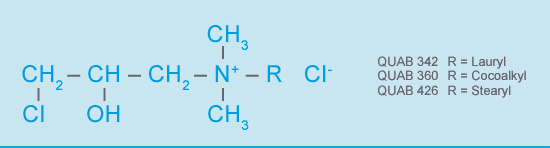
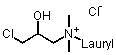
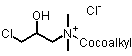
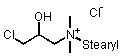
We also offer the QUAB Specialties QUAB 342, QUAB 360 and QUAB 426, which are the trade names for the solutions of the active substance 3-chloro-2-hydroxypropyl-alkyl-dimethylammonium chloride. In these products, a methyl group within the quaternary ammonium group is substituted by a long-chain alkyl group (R = dodecyl-, cocoalkyl- or stearyl-). These products are delivered exclusively as chlorohydrins.

QUAB 342 and QUAB 360 are sold as aqueous solutions with total active weight concentrations of approx. 40 % (chlorohydrin).

QUAB 426 is sold as a solution in a 1,2-propanediol / water mixture with approx. 40 % weight concentration (chlorohydrin)

QUAB 342
QUAB 360
QUAB 426

Formule empirique

C17H37Cl2NO
C13-23H29-49Cl2NO
C17-32H37-49C12NO

CAS.-Non.

41892-01-7
690995-44-9
3001-63-6

Numéro EINECS

255-578-9
440-100-5
221-083-1

Poids moléculaire

environ 342 g/mol
environ 360 g/mol
environ 426 g/mol

Apparition

liquide clair,
incolore à jaune clair
liquide clair,
incolore à jaune clair
liquide clair,
incolore à jaune clair

Odeur

pratiquement inodore

Densité (20 °C)

1,0 g/cm³
1,0 g/cm³
1,0 g/cm³

Point d'éclair (Abel-Pensky)

118 °C (244 °F)

Viscosité (20 °C)

environ 60 mPas
environ 80 mPas
environ 230 mPas

Miscibilité

miscible à l'eau et aux solvants organiques polaires (par exemple, méthanol, éthanol, isopropanol, butanol, acétone, hydrocarbures chlorés)

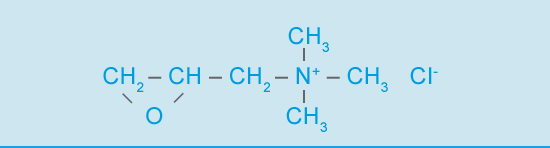
* Résultant de la pression partielle de l'eau dans le QUAB 188

Aqueous chlorohydrin solutions are stable and therefore storable at room temperature in a pH range of 2-6 for several years without any detectable loss of activity. At higher temperatures, the pH will be reduced over time. At storage temperatures below 20 °C (QUAB 426) and 10 °C (QUAB 342 and QUAB 360), waxy like solids may crystallize from the solution.

Suitable Materials:
Stainless steel, types 316L and 316TI (DIN 1.4571), are basically suitable for transport containers but are recommended for storage only with restrictions. Pickling of containers and pipes with attention to welds is mandatory. These materials are subject to pitting after prolonged periods of contact and at elevated temperatures. However, since transport containers are not subject to prolonged contact, these materials may be used for QUAB Specialties. Plastic containers may be used in all cases.

QUAB Chemicals recommends a coating for storage tanks made of stainless steel types, 316L and 316TI (DIN 1.4571). Alternatively, fibre reinforced plastic tanks or other coated storage containers may be used. Suitable materials for QUAB Specialties include polyester, polyethylene, PVC, heat cured phenolic resins or epoxy resins, neoprene, Buna S and Buna N. Enameled containers and tanks may also be used. Any damage in the coating must be repaired.

Matériaux inadaptés :
Pour Quab Specialties, les conteneurs en tôle de chaudière H II, en aluminium (99,5) et en acier inoxydable de type 304L et 321 (DIN 1.4541) ne conviennent pas. Les échantillons d'essai des types d'acier inoxydable 304L et 321 (DIN 1.4541) présentent des piqûres.

QUAB SPECIALTIES

QUAB 342
QUAB 360
QUAB 426

Fûts en PE (200 kg)

IBC (1000 kg)

Les produits énumérés dans le présent document sont vendus conformément aux lois et réglementations applicables. La vente de certains produits peut être interdite dans certaines régions.

QUAB 342
QUAB 360
QUAB 426

Teneur en chlorhydrine

≥ 38 %
≥ 38 %
≥ 38 %

Teneur en époxyde

≤ 500 ppm
≤ 500 ppm
≤ 500 ppm

Contenu actif* (en chlorhydrine)

≥ 38 %
≥ 38 %
≥ 38 %

Teneur en glycol**

≤ 2.5 %
≤ 2.5 %
n.s.

Epichlorohydrin (ECH)

≤ 10 ppm
≤ 10 ppm
≤ 50 ppm

1,3-Dichloropropanol

≤ 100 ppm
≤ 100 ppm
≤ 1000 ppm

pH***

2- 6
2 - 6
2.5 - 6.5

Informations complémentaires (ne faisant pas partie du cahier des charges)

Eau

55 - 58 %
55 - 58 %
29 - 31 %

1,2-Propanediol

-
-
23 - 28 %

* L'époxyde et la chlorhydrine constituent ensemble le contenu actif.
** Le quab-glycol est inerte dans les réactions de cationisation.
*** Solution non diluée

n.s. non spécifié

Pour des informations détaillées sur la sécurité, la manipulation et la toxicologie, voir les fiches de données de sécurité correspondantes, qui sont disponibles sur demande.

The substances are corrosive to the eyes and irritating to the skin. Basically the same safety measures for QUAB 188 and QUAB 151 apply to the QUAB Specialties.

QUAB 342, QUAB 360, and QUAB 426 are toxic to fish. Precautions must therefore be taken to prevent this product and its by-products from entering the aquatic environment.

The QUAB specialty products have not only cationic but also surface-active properties which are attributable to the long-chain alkyl groups. The dodecyl, cocoalky,l or stearyl groups lend hydrophobic (lipophilic) properties to the polymers modified by these QUAB reagents. This may cause foam formation when aqueous solutions are handled, particularly if there is strong mechanical agitation.